


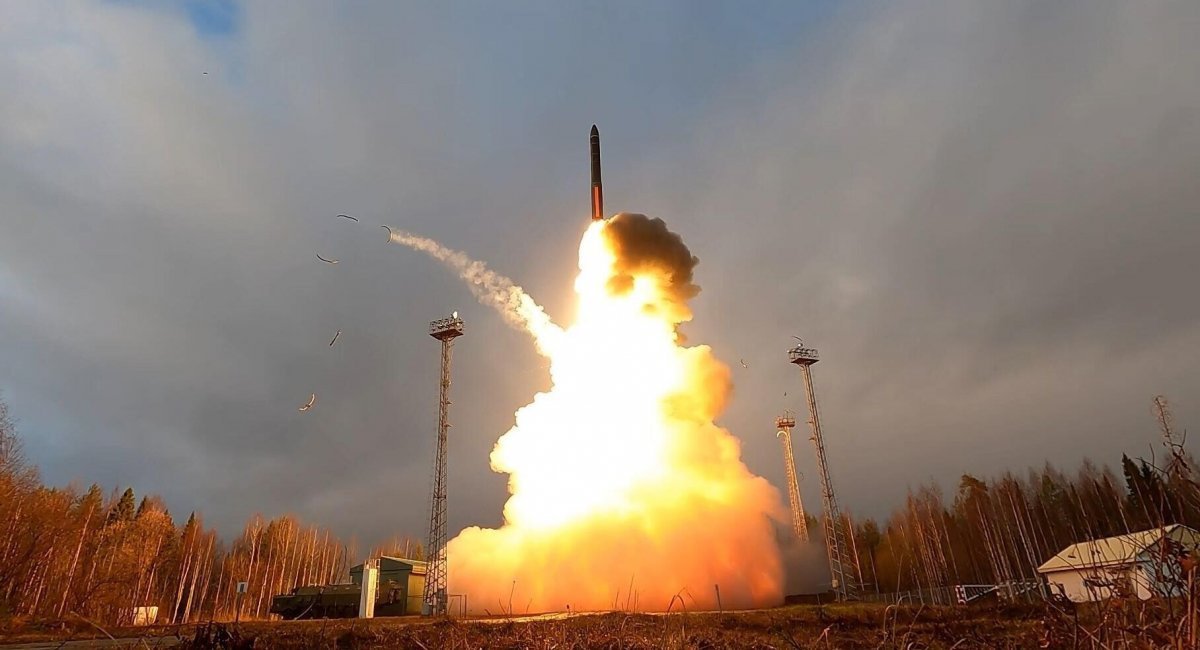
The strike using the Oreshnik missile on Bila Tserkva on the night of May 24 may indicate an increase in production tempo. The interval between the first two strikes on Dnipro and Lviv was approximately 13.5 months, while the gap between the second and third strikes was about 4.5 months. This pattern aligns with earlier assessments by Ukrainian intelligence regarding production scale and timelines.
In October 2025, during a briefing involving the President of Ukraine and heads of intelligence agencies, it was stated that russia planned to produce up to six Oreshnik missiles in 2026.
Read more: Impact Site Analysis Challenges russian Claims About Oreshnik's "Kinetic Superweapon"
After the second strike on Lviv on January 9, 2026, the First Deputy Head of the Foreign Intelligence Service of Ukraine, Oleh Luhovskyi, stated in an interview with Ukrinform that russia likely possessed no more than 3–4 missiles at that time, while planning to transition to serial production in 2026 at a rate of five or more units per year.
At the same time, according to data published by NV based on the Defense Intelligence of Ukraine, as of April 2026 russia reportedly held up to 10 Oreshnik missiles in its stockpile. From an analytical perspective, the wording "up to" indicates an upper bound rather than a precise figure.
Taken together, this suggests the beginning of limited-series production. Instead of vague estimates such as "a few units," intelligence assessments now refer to a more defined numerical range, indicating a shift toward structured manufacturing.
Other angles of the Oreshnik strike on Kyiv. https://t.co/ySDwXzwWGa pic.twitter.com/zWJcwhR9he— Clash Report (@clashreport) May 23, 2026
If the missile was not yet in serial production at the time of the second strike, then the May 24 strike may have occurred after initial production had already begun.
However, overall numbers remain limited, with estimated production rates of roughly one Oreshnik missile every 2 to 2.5 months. If serial production began around February–March 2026, russia would likely have produced only a small number of units by late May.
This supports earlier estimates that russia’s operational stockpile remained in the range of 3–4 missiles at the end of May.
Ukraine has also indirectly influenced production timelines. On February 21, 2026, Ukrainian forces reportedly struck the Votkinsk Machine Building Plant with an FP-5 Flamingo cruise missile. The facility produces not only Oreshnik components but also intercontinental ballistic missiles such as Yars and Bulava, as well as Iskander ballistic missiles.
It is also important to note that the Oreshnik missile, widely assessed as a derivative of the RS-10 Pioneer concept and based on the RS-24 Yars platform, reportedly uses the first two stages of that system. This assessment was first suggested by Defense Express in November 2024 and later confirmed by Ukraine’s Foreign Intelligence Service in December 2025.
Read more: Ukrainian FP-5 Flamingo-Equipped Brigade Identified Following Strike on russian VNIIR-Progress Plant