


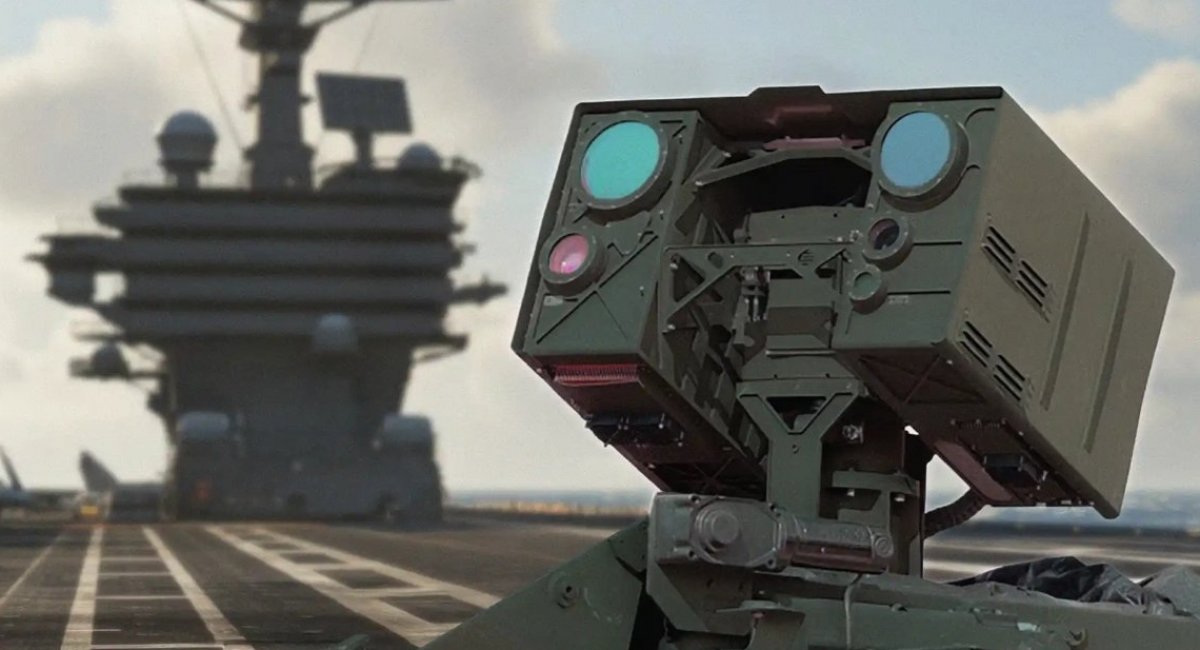
American company AeroVironment revealed details of a truly interesting experiment together with naval forces. In October last year, they conducted tests installing Locust laser system on nuclear aircraft carrier USS George HW Bush (CVN-77) in cheap and cheerful concept, securing it to the deck with chains, within demonstration of how anti-drone protection of combat ship can be truly quickly enhanced.
As AeroVironment now reports in their blog authored by Mary Clum and John Garrity, testing their Locust laser aboard aircraft carrier USS George HW Bush (CVN-77) lasted only one day, but they demonstrated viability of this variant of operating laser weapons on ships, even despite the solution to simply chain the system down may look like a crutch.
Read more: russians Suggest Copying Ukraine's Idea of Using the An-28 as a Platform for Anti-Aircraft Drones
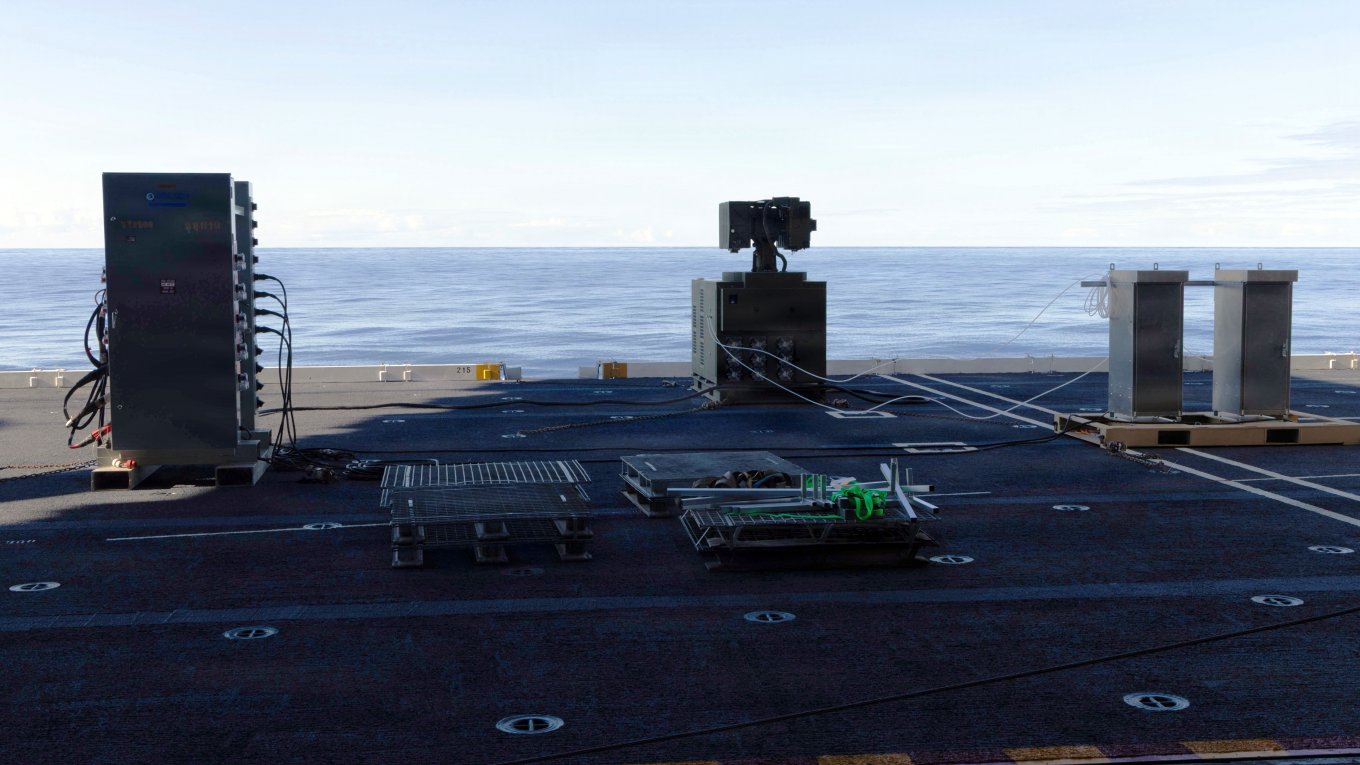
However, the company emphasizes, precisely such "palletized" laser weapons variant allows overcoming those limitations that arose under conditions of full system integration into ship, namely the need to send ship for maintenance in case of laser weapon problems or modernization need, high cost and duration of integrating laser weapons on ship, etc.
At the same time, thanks to palletized Locust variant, AeroVironment proved that ships can quite quickly enhance themselves with anti-drone systems, because within one day, laser weapons were delivered and installed on aircraft carrier, after which testing of this system immediately took place.
However, the main thing isn't even this, but the fact that, as the company says, aircraft carrier crew members who had never used laser weapons before could already capture and successfully destroy targets after an hour of operating Locust laser only after tens of minutes of training. It's stated that 100% of targets were shot down during tests.
Before simply taking and putting their Locust laser system on aircraft carrier USS George HW Bush, the company conducted serious preliminary work, because we're talking about electronics improvement for operational stability in maritime conditions, ensuring stabilization, etc.
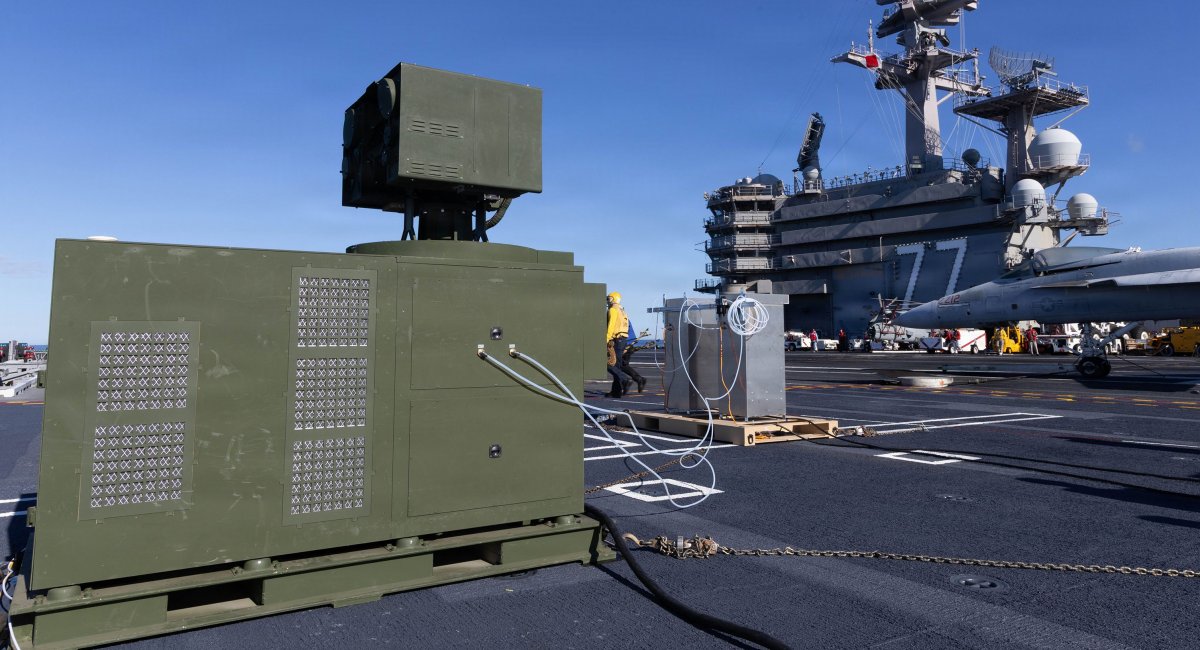
From nuances the post notes that test stand was located in such a place that normal flights had to be suspended for [testing] time, and that after tests the laser system had to be removed back so the aircraft carrier could resume its work.
This may be a problem in real combat, when drones need to be shot down not on schedule, but here and now. However, the problem may be solved by installing laser in other places. Also, besides aircraft carriers, Locust laser system can be operated on other combat ships as well.
Although more and more laser weapons samples are appearing in the world today, mass implementation and use of this technology in real conditions is still stalling compared to other modern anti-drone solutions. Laser weapons development is quite a lengthy process, often associated with a number of difficulties. First and foremost, we're talking about ensuring power supply, problems with which on large combat ships actually shouldn't exist.
Although several years ago, the U.S. Navy called for looking realistically at equipping ships with laser systems, at the same time whether complexes like Locust can become truly effective or at least intermediate solution will be shown by time as well as real combat applications.
Defense Express previously reported that shooting down Kh-101, Kalibr and other cruise missiles is still desired in U.S, where they're working on JLWS laser for this.
Read more: After Major Failures, ARRW Hypersonic Missile Critical Against russia, China Is Spotted on B-1B Lancer for the First Time