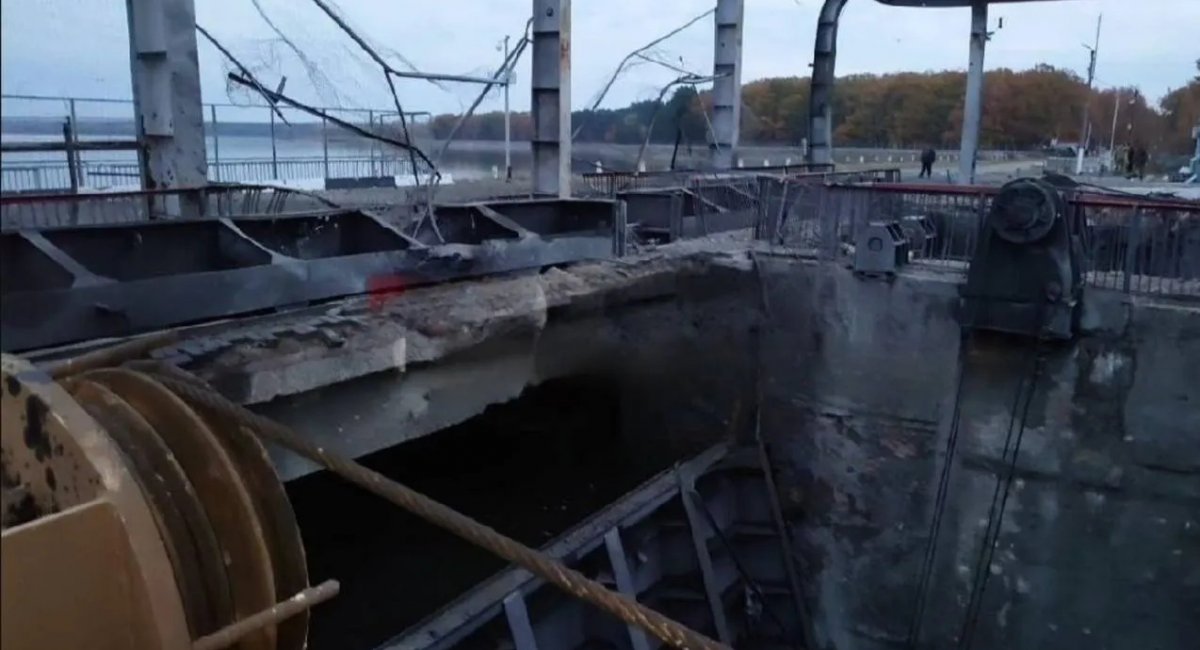
The attack, carried out by strike drones from the 1st Separate Center of the Unmanned Systems Forces (formerly the 14th Regiment), was confirmed on October 26 by Robert Madyar Brovdi, Commander of Ukraine's Unmanned Systems Forces and the 16th Army Corps.
"The Belgorod reservoir cracked today. Since the "magic kick," the water level has dropped by about one meter," Madyar wrote, referring to reports that russian dugouts near Hrafivka village were flooded following the strike.
Read more: Ukraine's Prymary Unit Destroy russian S-400, P-18, Nebo-U Radars and BK-16 Boat in Crimea (Video)
Satellite images released later that day confirmed visible destruction of the dam and large-scale flooding downstream.
"The satellite imagery clearly shows water from the breached Belgorod dam inundating areas below the reservoir. The flow continues to spread, covering new stretches of land," the monitoring channel Khartiya-97% reported on Telegram.
According to Vyacheslav Gladkov, governor of russia's Belgorod region, ten areas in the Shebekino district have already been flooded. russian media later reported that several units operating near Vovchansk — including elements of the 128th, 116th, 68th, and 136th Brigades — were caught in the affected zone.

Military analysts note that the flooding could severely complicate russian logistics and troop movements along the Siverskyi Donets River, where temporary bridges and crossings are crucial for supply and evacuation.
The 16th Army Corps of the Armed Forces of Ukraine confirmed that the flooding had indeed reached russian trench networks near Hrafivka and further downstream. The Corps also provided an update on the operational situation in the Vovchansk sector, noting that the enemy had earlier tried to exploit favorable conditions after a prolonged dry period.
"The enemy attempted to take advantage of the low water levels following an extremely hot summer. The dried-up riverbeds of the Siverskyi Donets and Vovcha simplified their logistics and allowed temporary local advances," the statement said.
However, Ukrainian forces emphasized that these russian gains came at a high cost. Several units reportedly suffered heavy losses, with some formations nearly losing combat capability.
"For example, the 1st Battalion of the 82nd Airborne Division was almost wiped out — only the command staff remained, and the unit had to be withdrawn for replenishment," Ukrainian sources reported.
Following the strike, the dam began releasing massive volumes of water, causing a one-meter drop in the reservoir level within a day. The water flowed into the Siverskyi Donets, flooding russian dugouts and supply points along the river.
"The main problem for the enemy now is logistics. The leaves have fallen, there's no cover, and units that managed to cross the Siverskyi Donets are effectively cut off from their main forces. We're expecting fresh additions to the exchange fund," the 16th Army Corps concluded — referring to potential russian prisoners of war.
Military experts suggest that the strike on the Belgorod dam may have served not only as a tactical disruption of russian supply routes but also as part of a broader counter-logistics campaign by Ukraine, targeting key infrastructure supporting russian operations near the border.
Read more: Atesh Partisans Disrupt russian Logistics in Occupied Crimea: Ammunition Supply Routes Severed