


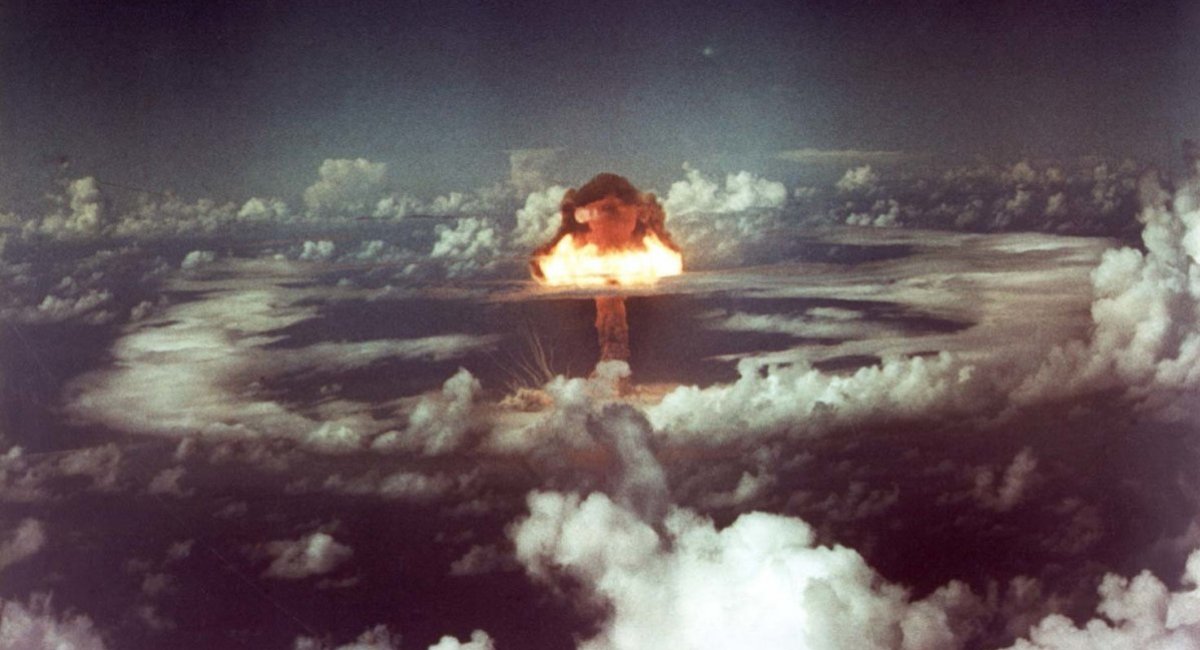
vladimir putin announced the start of preparations for "full-fledged nuclear tests." For now, the directive is formally limited to developing a plan that the government must draft and submit for approval by the Security Council — a move apparently intended to ensure collective responsibility among russia's ruling elite once the "green light" is given.
The intent to resume real nuclear testing first became clear two years ago, when in November 2023 Moscow withdrew its ratification of the Comprehensive Nuclear-Test-Ban Treaty (CTBT) of 1996.
Read more: NATO Admits It Could Lose Next War, But Does Alliance Know How to Prevent It?
Since then, russia has almost certainly been conducting large-scale preparations for potential tests at its historic Novaya Zemlya test range, which operated between 1955 and 1990. During that period, the site hosted 132 nuclear detonations, only 42 of which were underground. The rest were atmospheric or underwater. Among them was the detonation of the Tsar Bomba, a 58-megaton hydrogen device — the most powerful nuclear weapon ever exploded.
Since withdrawing from the CTBT, russia has faced no legal restrictions on conducting nuclear explosions. However, an important question remains: how such a test would be carried out and whether Moscow still considers itself bound by the 1963 Treaty Banning Nuclear Weapon Tests in the Atmosphere, in Outer Space, and Under Water, signed with the United States. That treaty is indefinite in duration but allows withdrawal with three months' notice.
The answer to that question will determine the type of test russia might conduct. An underground detonation, for example, would have limited public impact: visually amounting to little more than a shaking camera, as seen in U.S. underground tests in 1992.
A shallow-buried charge could produce visible ground collapse but little spectacle.
By contrast, an atmospheric detonation would be the first of its kind since 1980, when China carried out a 4-megaton test at the Lop Nur site. Such a display, however, may be precisely what Moscow wants to demonstrate.
A compromise option could be an underwater detonation, which provides dramatic visuals while releasing less radioactive material into the atmosphere.
It's also worth noting that in most nuclear tests, the warhead itself was tested separately from its delivery vehicle. These tests were primarily scientific and technical — focused on measurement, diagnostics, and validation of design concepts. Whether the Kremlin might actually launch a missile with a live nuclear warhead toward the Novaya Zemlya range depends on entirely, as some analysts put it, on the psychological state of vladimir putin.
Ultimately, russia's intent to resume nuclear testing, whatever form it takes, is yet another reminder that nuclear threats remain the Kremlin's primary means of communicating with the civilized world.
Read more: Kinzhal and Zircon Missiles Could Easily "Blind" the U.S. to a russian Nuclear Strike, But It's Not That Simple