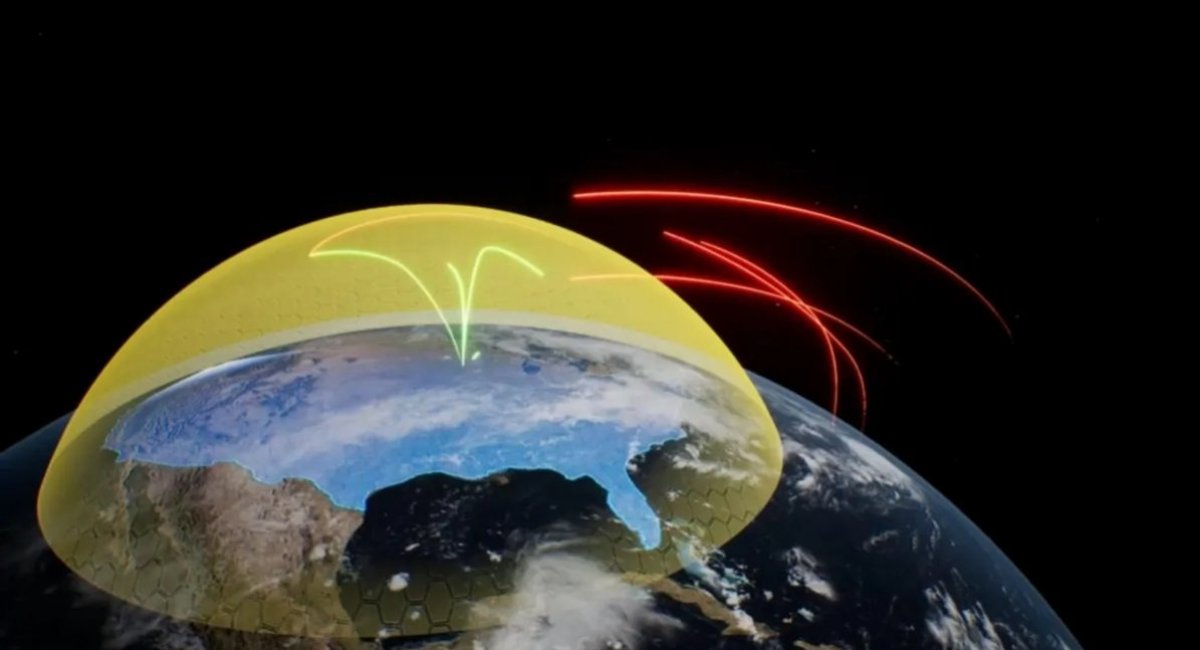
The American Golden Dome national missile defense initiative launched under the administration of U.S. President Donald Trump could ultimately become the most expensive military program ever undertaken.
The Congressional Budget Office (CBO) has released a new estimate of the project's projected costs, and the numbers are staggering.
Read more: America's Golden Dome at Risk: U.S. Faces Time and Cost Challenges in Key Defense Program
According to the CBO, development and sustainment of the Golden Dome architecture over the next 20 years could cost as much as $1.2 trillion. That figure exceeds the current annual U.S. defense budget of slightly more than $900 billion and is only around $300 billion lower than the proposed $1.5 trillion defense budget projected for next year, according to Defense News.
The estimate is based on the construction of a four-layer missile defense architecture that would include a space-based component alongside multiple ground-based interceptor systems.
The network is intended to protect the continental United States, Alaska, and Hawaii from a broad spectrum of threats, including ballistic and hypersonic missiles.
Most notably, the CBO report concludes that even with such unprecedented funding, the system still may not be capable of reliably defending against large-scale attacks by adversaries such as russia or China.
The report does not fully explain this conclusion. However, the logic appears relatively straightforward. Even the most advanced missile defense network can potentially be overwhelmed by mass attacks involving large numbers of inexpensive drones and comparatively cheap missiles, both of which are becoming increasingly common in modern warfare.
At the same time, Golden Dome is not some ultimate "wonder weapon" but rather an extremely complex layered defense architecture. The project could therefore encounter serious practical problems from the outset, especially given existing shortages of interceptors for systems such as the MIM-104 Patriot and THAAD, as well as the loss of valuable radar assets such as the AN/TPY-2 following Iranian strikes in the Middle East.
The CBO estimate is also roughly six and a half times larger than the amount proposed by the Trump administration for Golden Dome in the 2027 defense budget, which currently allocates a comparatively modest $185 billion.
Part of the discrepancy likely stems from the fact that neither the White House nor the Pentagon has yet presented a finalized vision of what the Golden Dome architecture will ultimately look like.
The concept itself emerged almost immediately after the beginning of Trump’s second presidential term. Initially, the initiative was even referred to as the Iron Dome, creating confusion with Israel’s Iron Dome.
This is also far from the first American attempt to create a massive strategic missile shield. One obvious historical parallel is the Strategic Defense Initiative launched by Ronald Reagan in 1983, which ultimately failed to achieve its goals.

Whether Trump's Golden Dome project will succeed remains an open question. The scale of the initiative is enormous, including renewed American ambitions for lunar infrastructure and even discussions about future bases on the Moon. Such ambitions hint at the possibility that Washington may eventually seek to integrate space and lunar infrastructure into a future missile defense network.
From Defense Express' perspective, Golden Dome largely reflects Trump's preference for massive strategic weapons programs in which scale and ambition often outweigh practical considerations and cost efficiency.
While the overall concept of a multilayered missile defense shield is not inherently unrealistic, the project would require extraordinary financial resources, risks turning into a decades-long megaproject, and offers no guarantee that future U.S. administrations will continue funding it in its current form.
Read more: From Secret Deliveries to Ukraine to $151 Billion Golden Dome: V2X Joins U.S. Missile Defense Program