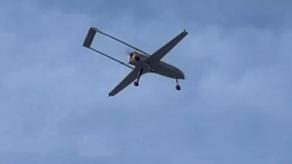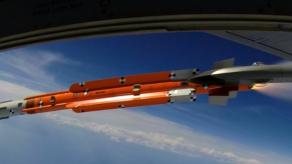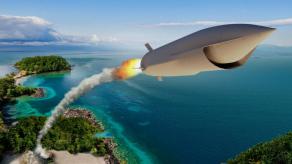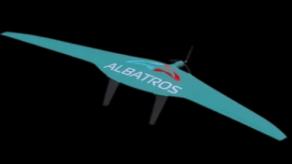
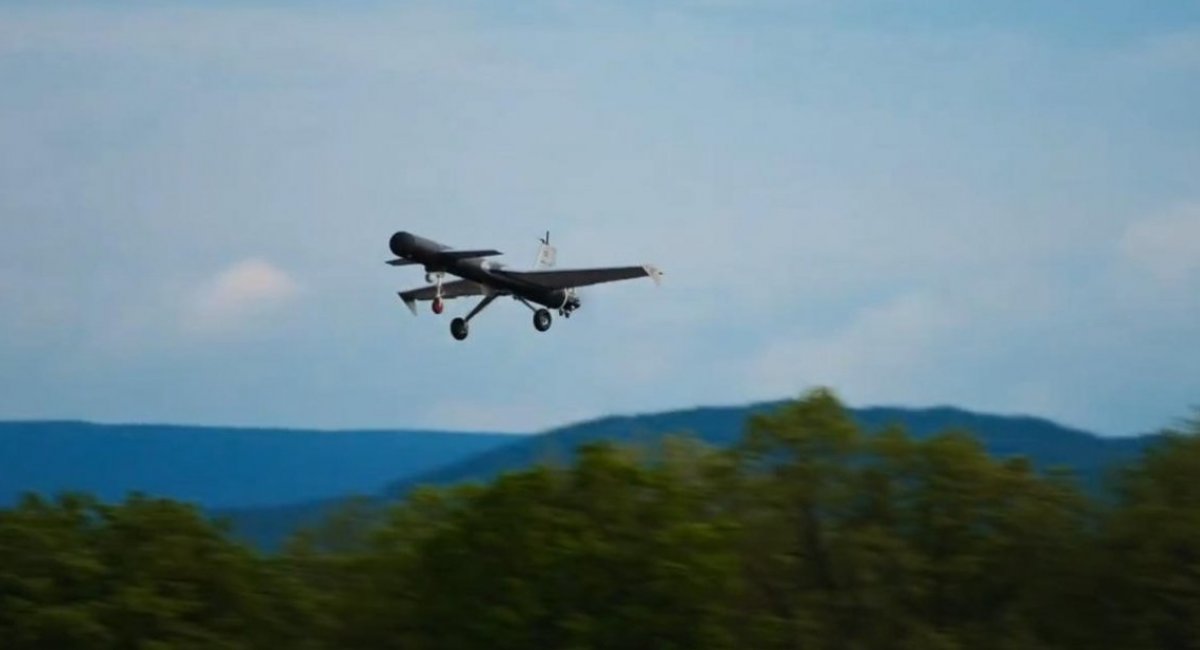
Turkish defense company Baykar will showcase its new development called Mizrak for the first time at the SAHA 2026 exhibition, running May 5–9 in Istanbul. Positioned as an intelligent loitering combat system, it is essentially a long-range strike drone with a declared range of over 1,000 km, available in two variants.
The first variant will carry a 40 kg warhead, while the second will carry a lighter 20 kg warhead offset by the addition of a seeker head for precision target detection and engagement. The Mizrak is also noted to offer operators broad reconnaissance and surveillance capabilities through the integration of an electro-optical or infrared camera depending on mission requirements.
Read more: Carrier Crew With Zero Laser Training Shot Down 100% of Targets After Just Tens of Minutes With Locust
In terms of other technical specifications, the Mizrak has a wingspan of 4 m, a length of 3.6 m, and a height of 1.2 m. Maximum takeoff weight is 200 kg, maximum speed is approximately 185 km/h, endurance is 7 hours, and range, as noted, exceeds 1,000 km. A communications range of 80 km has also been declared.
The drone features an AI-assisted autopilot enabling it to autonomously execute missions in complex environments. In essence, the Mizrak is a multi-role drone capable of conducting reconnaissance operations, functioning as a precision loitering munition, and carrying out deep-strike missions.
This is already at least the third such development from Baykar in just a few months. As with the K2 — first unveiled in mid-March, the Mizrak exhibits the same fundamental flaw: an attempt to merge two distinct concepts in a single airframe. In this case, those are a high-tech loitering munition and a long-range strike drone, the latter of which must be as low-cost and mass-producible as possible.
That said, the existence of two distinct configurations may allow the company to differentiate the two variants in terms of unit cost. It is also possible that Baykar is pursuing a concept of swarming with mixed drone types, where the K2, for instance, serves as the primary strike element, while the Mizrak is primarily aimed at enemy air defense assets.
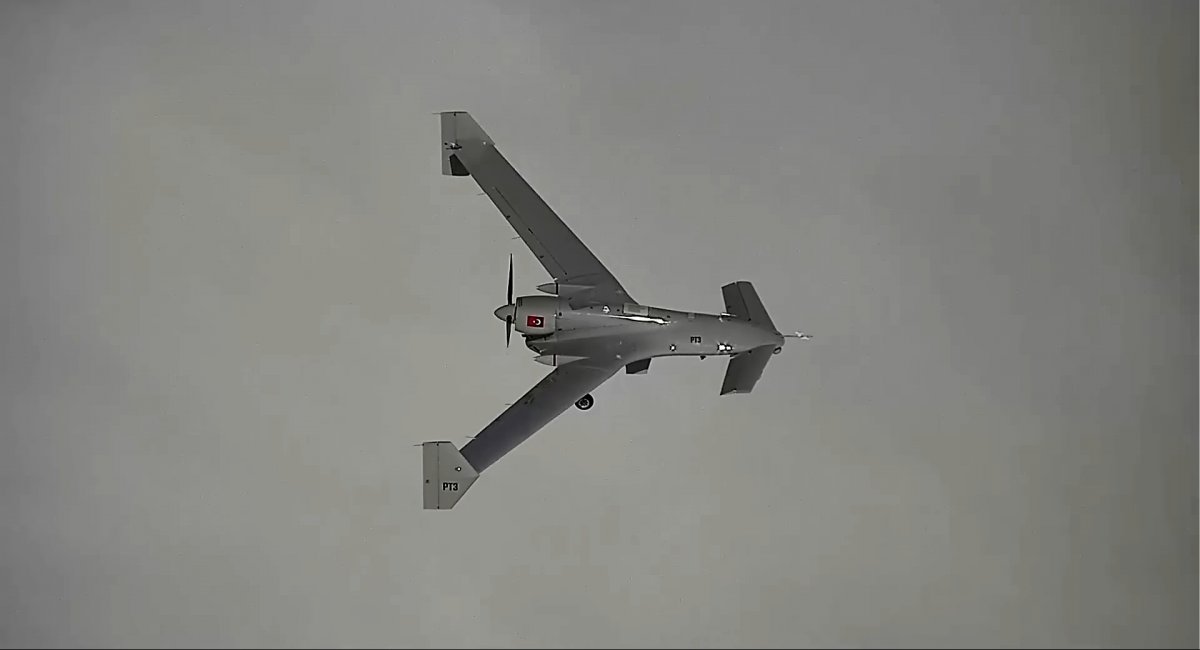
Also debuting at the May exhibition will be Baykar's Sivrisinek drone, which is likewise a long-range strike unmanned system with a 1,000 km range, AI integration, and swarming capabilities.
Still, a question arises: why does one company need three drones with partially overlapping roles? The K2, for example, is also a long-range drone that can additionally serve as a reusable bomb carrier.
Compared to the Mizrak, the K2 offers twice the range at 2,000 km as well as a far more powerful 200 kg warhead. On the other hand, it is a considerably larger aircraft, making it a far easier target for air defense systems. The result is three drones that all share a deep-strike capability, while also incorporating other functions that are typically handled by entirely different drone categories on the battlefield.
And that is without even accounting for the fact that these are three developments from a single company, while Turkish defense firm STM had already unveiled its own Shahed-type system capable of striking targets thousands of kilometers away, which will inevitably compete with Baykar's lineup.
Read more: Ukrainian Baba Yaga Heavy Drone Strikes russian Forces Near Huliaipole Using Machine Gun and Dropping Munitions