


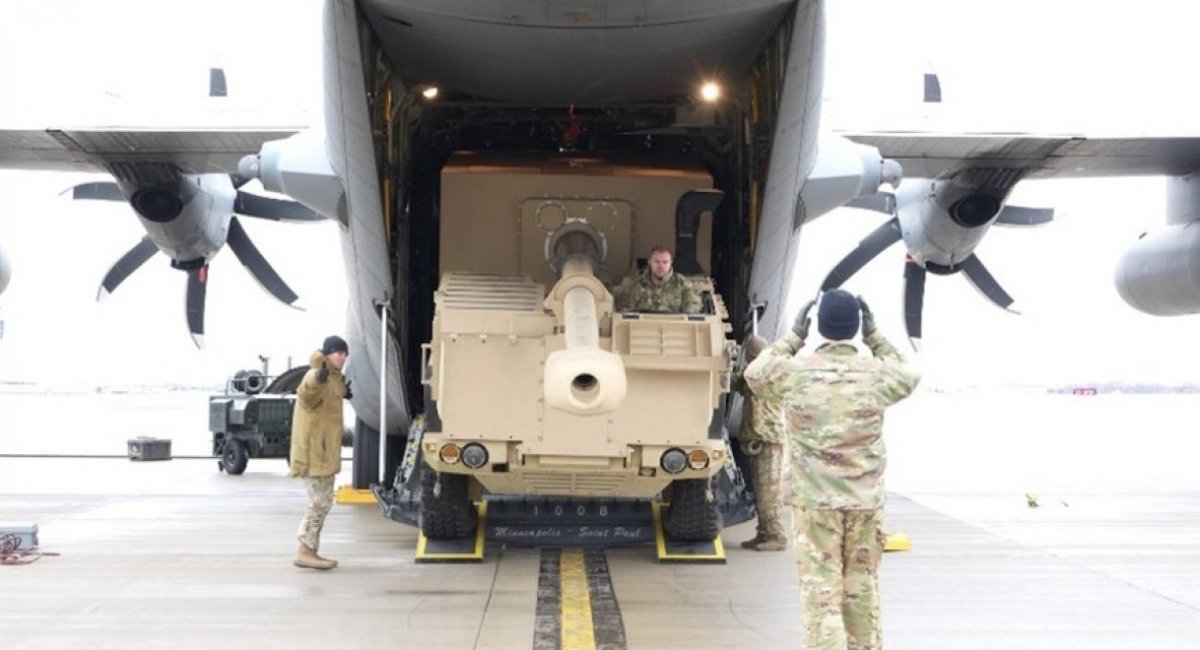
American defense company BAE Systems has finally unveiled the new 155 mm Multi-Domain Artillery Cannon System (MDACS), a self-propelled artillery platform designed not only for traditional fire support missions, but also for air defense against drones and cruise missiles. The system was showcased during the LANPAC 2026 conference in the United States, highlighting Washington's growing interest in cheaper and more scalable counter-air solutions.
The first released image shows the MDACS being unloaded from a Lockheed C-130 Hercules transport aircraft, underlining one of the U.S. Army's key requirements for the project – strategic mobility. The ability to rapidly deploy the system by air could make it particularly valuable for expeditionary operations across the Indo-Pacific or Europe.
Read more: Turkish Baykar Expands European Cooperation With Strategic Safran Deal, ITAR-Free Euroflir to Equip TB2 for Global Markets
The Multi-Domain Artillery Cannon System (MDACS) is built to move fast and hit hard. Air transportable and armed with Hypervelocity Projectiles, it delivers rapid, high-rate firepower wherever the fight demands. This is the future of adaptable, unstoppable artillery. #MDACS… pic.twitter.com/3djixFCx4N
— BAE Systems, Inc. (@BAESystemsInc) May 14, 2026
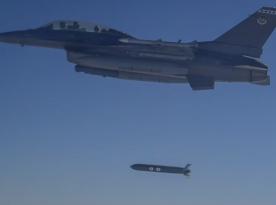
The core feature of the MDACS concept is its use of the new Hypervelocity Projectile (HVP), a high-speed guided munition originally developed for advanced naval guns. According to previously announced specifications, the HVP can engage targets at ranges up to 80 kilometers when fired from ground-based artillery systems, potentially giving the MDACS both long-range strike and air defense capabilities.
The system reportedly has a rate of fire of eight rounds per minute, while each projectile carries a 15-pound (6.8 kg) payload. Test imagery circulating online suggests that live-fire trials have already taken place. Although the MDACS can engage conventional ground targets, its anti-air role is drawing the most attention, especially its potential ability to intercept drones, cruise missiles, and possibly even aircraft.
Such a concept could address one of the most pressing challenges in modern warfare: the high cost of missile-based air defense. Interceptors for modern surface-to-air missile systems often cost hundreds of thousands or even millions of dollars, while threats like Iranian-designed Shahed drones or russian cruise missiles are comparatively inexpensive. A gun-based interception system using HVP rounds could significantly reduce the cost per engagement.
The U.S. Army's interest in the program became public in late 2024, when reports emerged that it planned to procure a prototype MDACS battery from BAE Systems. The planned battery structure reportedly includes eight self-propelled guns with a combined ammunition load of 144 rounds, four multifunction radars, and two command-and-control vehicles. Initial delivery of the prototype battery was expected in the fourth quarter of 2027, followed by capability demonstrations in 2028.
Now that the artillery platform itself has appeared publicly, the program may be progressing on schedule or potentially even ahead of it. The broader viability of artillery-based air defense will depend on future testing, but the idea is not entirely theoretical. Back in 2020, the experimental XM1299 system successfully struck a cruise missile surrogate using an HVP round, suggesting that such a capability may indeed be achievable in practice.
If the MDACS concept proves effective, it could represent a major shift in air defense doctrine, blending traditional artillery with modern anti-air warfare. At a time when mass drone attacks are reshaping battlefields from Ukraine to the Middle East, systems capable of delivering affordable interceptions at scale may become increasingly important for future militaries.
Read more: Libya Receives russian Tanks With Ukraine-War Drone Defenses