As part of efforts to reduce russia's offensive capabilities, Ukrainian forces carried out a series of strikes on the night of January 22 against key military and logistical targets linked to the russian war effort. The General Staff of the Armed Forces of Ukraine confirmed the operation later the same day.
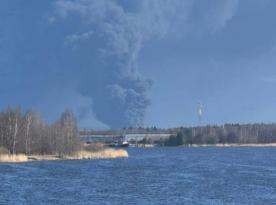
One of the primary targets was the Tamanneftegaz oil terminal located near the settlement of Volna in russia's Krasnodar Krai. The facility is directly involved in supplying fuel to russian units. A confirmed hit resulted in explosions and a fire at the site, with the extent of the damage still being assessed.
Read more: Ukraine Knocks Out One of russia's Rarest EW Assets Near Vovchansk (Video)
In parallel, Ukrainian forces struck several high-value targets in temporarily occupied Crimea, focusing on russia's air surveillance and early warning capabilities.
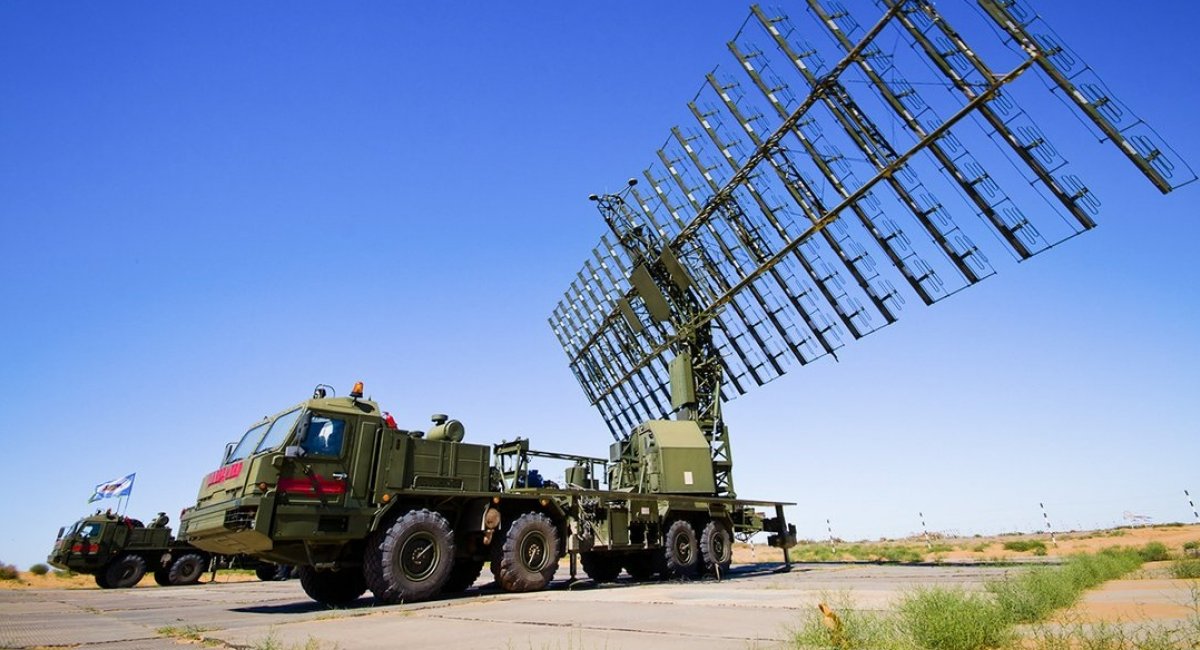
Confirmed hits were reported on the 59N6-E Protivnik-GE radar near Libknekhtivka, the 55Zh6 Nebo-U radar in Yevpatoria, and advanced 55Zh6M Nebo-M radar near Rusakivka. The degree of damage to these systems is still under evaluation.
These radar stations play a critical role in detecting aerial threats and supporting russia's integrated air defense network over Crimea and the Black Sea region. Their degradation could reduce situational awareness and weaken air defense coverage, increasing the vulnerability of military infrastructure in temporarily occupied territories.
Additional strikes were conducted against russian targets in other temporarily occupied regions of Ukraine. Among them was a UAV storage facility near Novohryhorivka in Kherson region, aimed at disrupting the enemy's drone operations. Ukrainian forces also hit a company-level command and observation post of the 76th Air Assault Division and a concentration of personnel from the 74th Motorized Rifle Brigade near Selydove in Donetsk region.
The General Staff also specified the results of an earlier strike on an ammunition depot belonging to the 101st Separate Logistics Brigade in Debaltseve, Donetsk region. The attack was confirmed to have caused a large-scale detonation, indicating significant losses of stored munitions.
As Defense Express previously reported, between January 17 and 19, Ukraine's Unmanned Systems Forces conducted a series of coordinated strikes against high-value military and infrastructure targets in temporarily occupied territories.
The operations were confirmed by Robert Brovdi, also known by his call sign Madyar, and reflect a growing emphasis on deep and middle-range precision strikes.
Read more: russian S-300V System, MLRS, Rail Power Substations Destroyed in Ukrainian Strike Series (Video)