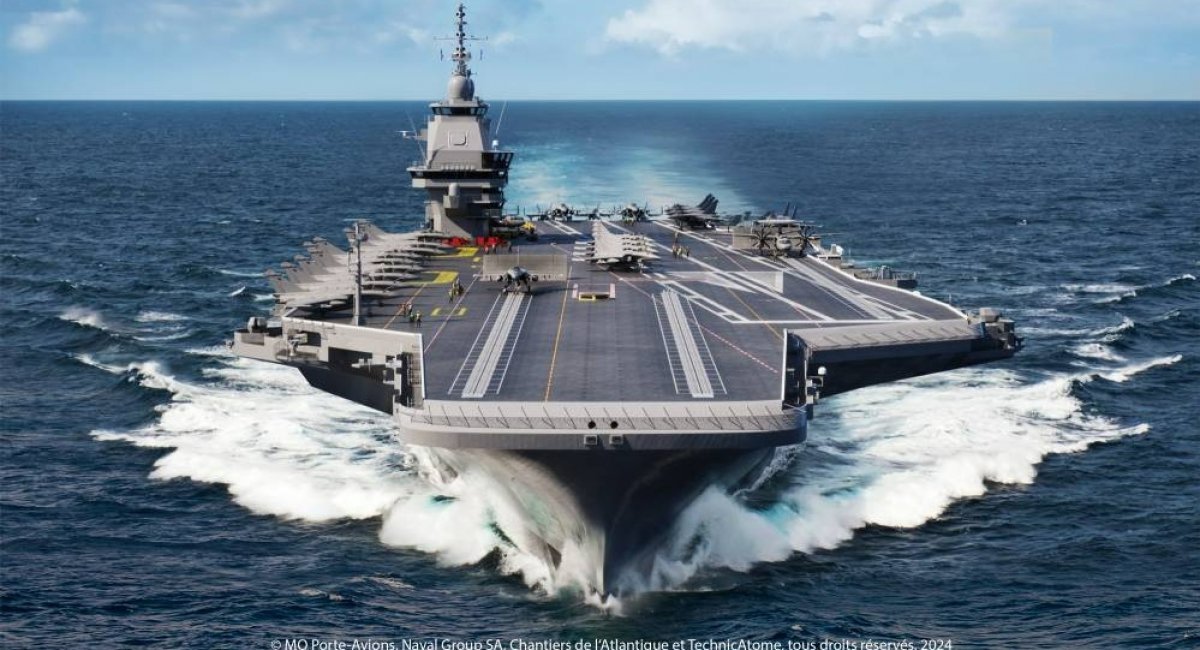
The new PANG aircraft carrier is expected to be roughly twice the size of the existing Charles de Gaulle. A decision on whether to formally launch the program was required by the end of 2025, as any further delay would risk the loss of critical industrial competencies and specialized skills.
French President Emmanuel Macron announced the decision to proceed with the project, which until now had remained at an early conceptual stage, during an address to French military personnel stationed at the Camp de la Paix military base in Abu Dhabi, UAE.
Read more: While France Stalls FCAS, General Atomics Offers Germany Its Gambit Fighter Drone
The future carrier is planned as a nuclear-powered vessel with a displacement of around 80,000 tons and a length of approximately 310 meters. In terms of displacement, it will be nearly twice as large as Charles de Gaulle (42,000 tons and 262 meters in length) and will carry a significantly larger air wing (the current carrier operates about 40 aircraft). However, it will still be smaller than the latest US Gerald R. Ford–class aircraft carriers, which displace around 100,000 tons and are 27 meters longer.
The decision on whether to authorize full-scale development of the PANG program was scheduled for the end of 2025. According to the current timeline, construction is expected to begin in 2031, with sea trials planned for 2035.
The announcement of this ambitious and extremely costly project comes at a challenging time for the French economy. Nevertheless, as President Macron stated, "in a time of predators, the country must be strong." The timely construction of the aircraft carrier is also closely tied to the preservation of critical competencies, which risk being lost if the program is delayed. Under current plans, the PANG carrier is expected to become fully operational by 2038, without schedule slippage.
In France, there has been active debate about postponing the start of construction by at least several years. However, according to the Ministry of Defence, even such a seemingly minor delay would have catastrophic consequences.
Charles de Gaulle is unlikely to remain in service into the 2040s. Without an operational aircraft carrier, a crew of around 1,400 personnel, including pilots and deck aviation technicians, would be reassigned ashore for several years. After such a hiatus, the entire process of rebuilding the carrier air wing and retraining specialized personnel would effectively have to begin from scratch.
Moreover, abandoning the concept of a nuclear-powered aircraft carrier altogether, an idea that has also been voiced in Paris, would threaten the loss of expertise in building highly complex warships and naval nuclear reactors.
For this reason, the decision on whether to build the PANG carrier, and whether to adhere strictly to the planned timeline, has often been contrasted with russia's experience with its sole non-nuclear aircraft carrier, Admiral Kuznetsov. In recent years, the vessel has suffered fires, flooding, and prolonged deterioration, and is now likely either to be scrapped or sold, if anyone is willing to buy it.
Read more: russia Eyes Decommissioning of Admiral Kuznetsov But Still Invests in New Warships