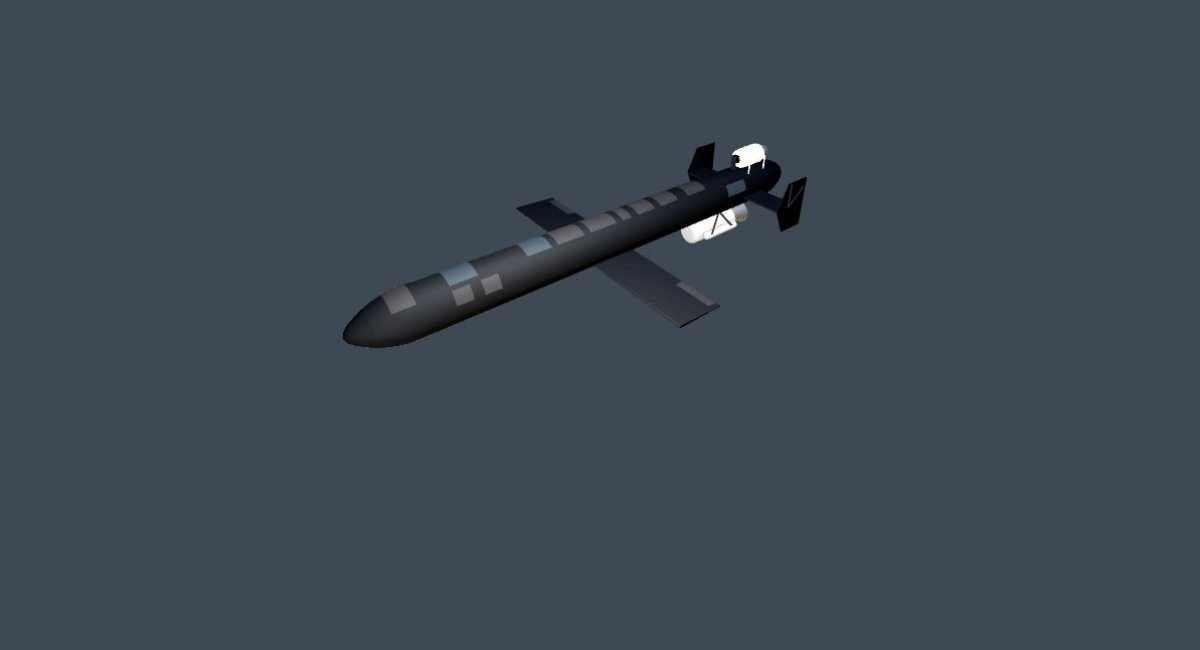
russia has initiated limited operational deployment of its new long-range weapon, the Geran-5 UAV. Equipped with a turbojet engine, this system effectively functions as a cruise missile rather than a traditional loitering munition.
According to specifications released by the Defense Intelligence of Ukraine (DIU), the Geran-5 has a Maximum Take-Off Weight of 850 kg, a cruising speed of 450-600 km/h, a flight endurance of approximately 2 hours, and a range of up to 950 km. Its service ceiling is 6 km, though observed flight altitudes range between 0.2 and 3 km. The airframe, including the wings and tail unit, is constructed from carbon fiber.
Read more: russian Geran-3 Drone Revealed to Contain Chinese Engine and Western Components
The Geran-5 serves as a clear indicator that such production is only viable due to the supply of key components from China. These strike assets would be non-existent without Chinese hardware - primarily the TF-TJ2000A small-scale turbojet engine manufactured by Telefly, which provides 1.95 kN (200 kgf) of thrust.
This is not the first instance of russian forces utilizing Telefly's miniature turbojets for the Geran series. Notably, the Telefly JT80 powers the jet-driven Geran-3. The company openly maintains its presence in the russian market while claiming its products are intended solely for non-military use.

A second critical Chinese component is the Xingkai Tech XK-F358 mesh modem. This hardware enables continuous communication and control via a dynamic daisy-chain relay network, allowing the long-range weapon to be piloted in a manner similar to an FPV drone.
Much like the turbojet engines, Chinese suppliers position these modems as exclusively civilian-grade hardware. However, such exports likely occur with, at the very least, the tacit approval of Beijing.
The system also utilizes 3G/LTE modems as a redundant communication channel - a long-standing practice in russian drone operations. Other electronic internals of the Geran-5 largely mirror the propeller-driven Geran-2, featuring the Kometa satellite navigation system with 12 CRPA elements and a Raspberry Pi microcomputer.
Previous reports from the DIU indicate that the Geran-5, based on the Iranian Karrar design, can potentially carry R-60 and R-73 air-to-air missiles or be integrated with Su-25 ground-attack aircraft.
Read more: Can russia Launch Geran-4 and Geran-5 from Su-25 Aircraft, and What Threat Would That Actually Pose?