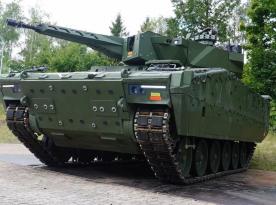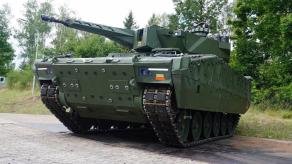




After years of delays and controversies, the British Army's Ajax armored vehicle program has officially reached its Initial Operating Capability (IOC) milestone, marking a small but notable step forward in one of the UK's most troubled defense projects. The Ministry of Defense confirmed that Ajax vehicle and the units equipped with it now demonstrate a "minimum acceptable level of capability", although full operational readiness is still years away.
Initially selected in 2010 as part of a major modernization effort, the Ajax vehicle was meant to achieve full deployment by 2017. However, after repeated technical issues and budget overruns, the Full Operating Capability (FOC) is now projected only around 2028-2029. The vehicle, based on the ASCOD 2 platform developed by General Dynamics, is assembled in Wales at the company's plant in Merthyr Tydfil.
Read more: HIMARS Could Take Five Years to Arrive, Yet Hungary Revives Purchase Talks

The Ajax program has faced intense criticism due to a series of scandals, most notably reports of excessive noise and vibration that caused hearing loss among crews during testing. The Ministry of Defense attempted to address the issue with improved seat cushions and noise-canceling headsets, but the problems appear to persist, soldiers continue to be hospitalized after training sessions on the vehicles.
Financially, the project has also spiraled out of control. Originally planned at £3.5 billion for 589 vehicles, the cost ballooned to £5.5 billion by 2023, while only 165 units have been delivered so far. Former Defense Secretary Ben Wallace openly called the Ajax "a ridiculous project" and "the very worst of indecision and capability", expressing regret that the UK did not instead procure the CV90 infantry fighting vehicle, widely considered a more reliable European alternative.
Despite these failures, the Ajax family of vehicles is still intended to form a key component of the British Army's next-generation reconnaissance and armored capability. The family includes the Ajax IFV with a 40 mm CTA International autocannon, the Ares APC, the Atlas and Apollo support variants, the Argus engineering vehicle, and the Athena command post.
These machines are expected to replace the aging Warrior IFVs, which will not be transferred to Ukraine, and fill the gap left by the retiring CVR(T) series (Scorpion and Scimitar). Whether the Ajax vehicle can overcome its ongoing performance and safety concerns remains uncertain, but for now, the UK's long-delayed armored modernization program has at least inched forward.
Read more: Billion-Pound Watchkeeper Failure May Be Replaced by Ukrainian Raybird ACS-3 UAS in the United Kingdom