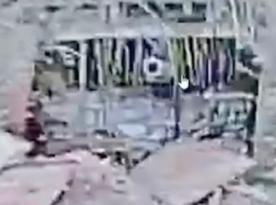
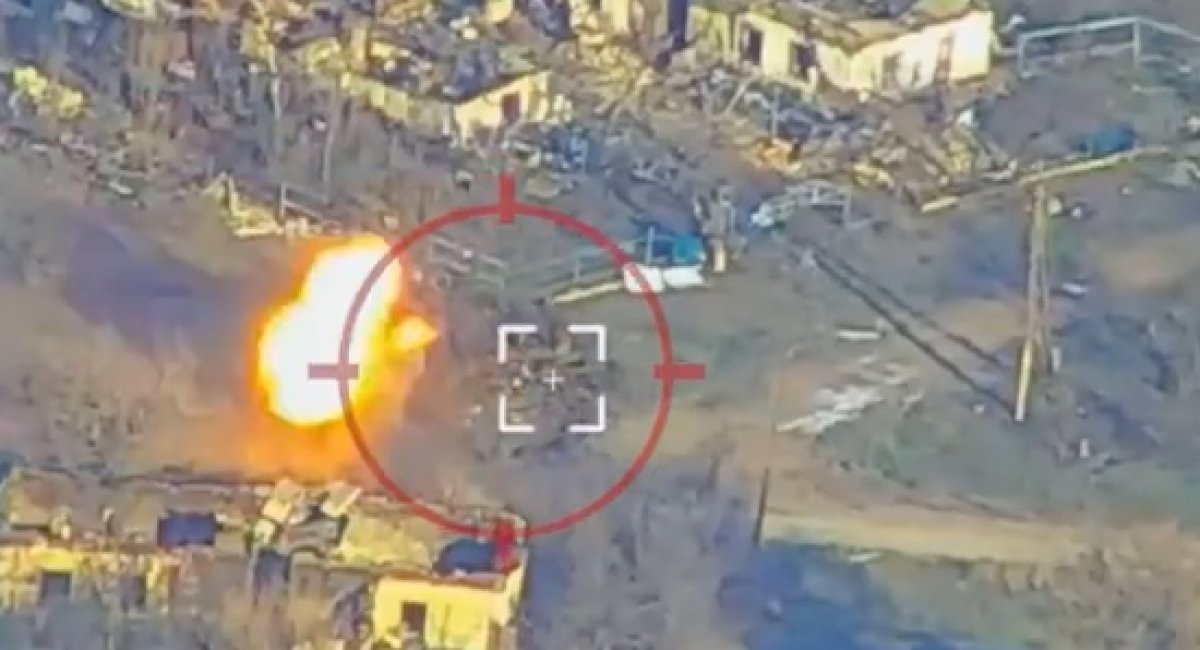
Operators of the Raid 413th Regiment of Ukraine's Unmanned Systems Forces have reported the successful destruction of russian so-called turtle tank on one of the most contested sectors of the front line. Footage released by the unit shows a UAV strike against the heavily modified armored vehicle, which is part of a limited and increasingly desperate category of russian assault platforms.
These turtle tanks are typically deployed at the head of armored columns during massed mechanized assaults against Ukrainian defensive positions. Their role is to absorb initial fire, trigger mines, and create a breach for following vehicles. In some cases, they are additionally equipped with mine-clearing rollers, reinforcing their function as expendable spearhead assets rather than maneuverable combat tanks.
Read more: Ukrainian Air Assault Troops Repel russian Offensive, Destroy Tank and Armored Vehicles Near Pokrovsk (Video)
The defining feature of such vehicles is the extensive welded-on armor plating that fully encloses the turret and, in some configurations, much of the hull. This crude protection is intended to counter FPV drones and loitering munitions, which have become one of the primary threats on the modern battlefield. However, the exact tank model used in the destroyed vehicle is difficult to identify due to these modifications.
In most documented cases, russia converts older main battle tanks, primarily T-62 and T-72, into turtle variants. These legacy platforms are already strained by age and wear, and the additional armor further degrades their performance. Rather than enhancing survivability in a balanced way, the modifications turn the tanks into slow, mechanically fragile machines with severely limited situational awareness.
The very existence of turtle tanks highlights the degradation of russia's armored forces and its defense-industrial base. Unable to field a modern heavy armored personnel carrier comparable to Israel's Achzarit or Namer, vehicles designed from the outset for survivability in high-threat environments, the russian military has resorted to improvised solutions that sacrifice mobility, reliability, and crew effectiveness.
Moreover, the reliance on welded armor shells is an implicit admission of failure by russia's much-publicized active protection systems, such as Arena APS. These systems were advertised as a technological answer to modern anti-tank threats, yet their absence on the battlefield and the turn toward crude physical shielding suggest they have proven ineffective or unavailable in practice.
Russian sources themselves acknowledge that these overburdened vehicles frequently break down before reaching deployment lines, with excessive stress on the chassis, suspension, and drivetrain. As a result, assaults are often disrupted or fail outright.
The destruction of another turtle tank by Ukrainian drones underscores that such improvisations do not reverse the broader trend: russian armored units are increasingly vulnerable, while Ukraine continues to exploit precision UAV strikes to dismantle even the enemy's most heavily modified platforms.
Read more: russian S-300V System, MLRS, Rail Power Substations Destroyed in Ukrainian Strike Series (Video)