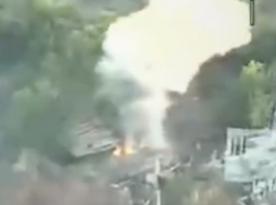



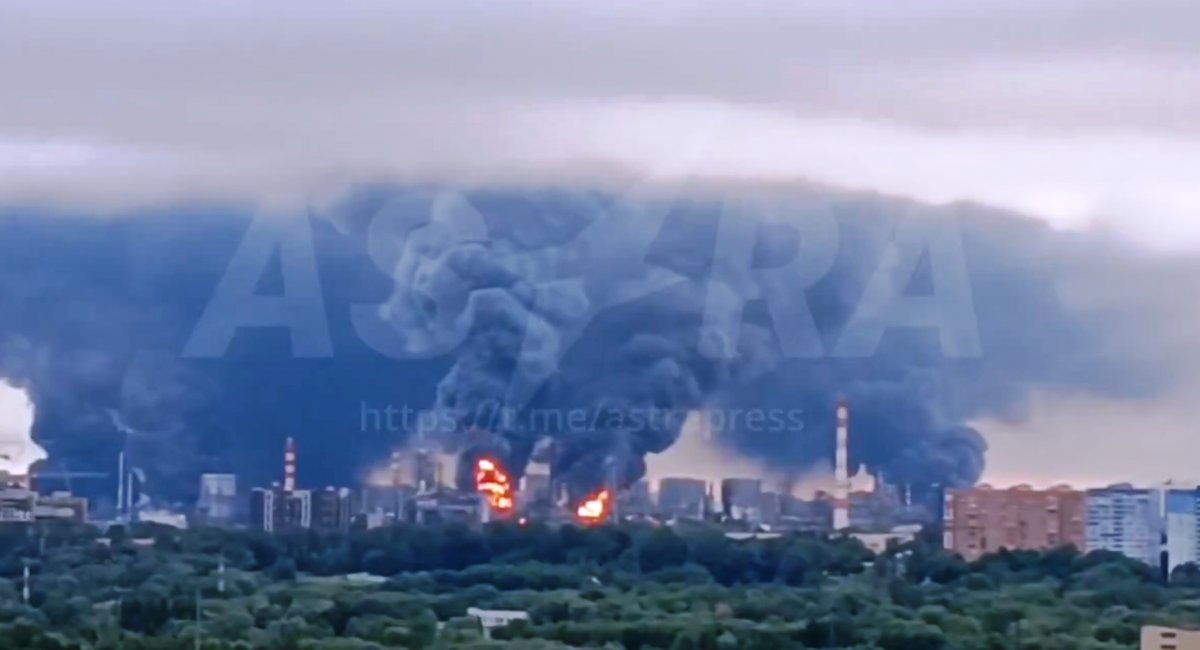
On the morning of June 18, Ukrainian drones struck the Moscow oil refinery in Kapotnya District for the second time in three days. This attack caused a massive fire. OSINT communities have published preliminary geolocations of the fire sites, with video evidence indicating at least five fires and one tank explosion that displaced a lid. Moscow's mayor Sergey Sobyanin publicly reported that the attack had been repelled, but at the same time acknowledged that the drones had reached the refinery.
Moscow came under a large-scale drone attack, with the oil refinery struck again and a major fire breaking out across multiple hotspots. Analysts from the Dnipro OSINT (Garbuz) community released geolocations showing the aftermath of the strike. Footage posted online by local residents shows a large fire at the refinery, with one video capturing an explosion blowing off the top of a tank. At least five fires have been identified, with explosions still being reported.
Read more: Ukraine's New P1-SUN Long Can Hunt Shahed Drones at Twice Distance and Already Has Combat Kills
According to estimates, the number of drones involved in the attack—officially acknowledged by Moscow's mayor—has reached 194. On the morning of Thursday, June 18, Moscow suffered its largest drone attack since the start of the full-scale war against Ukraine. A total of 527 flights were canceled or delayed at all of Moscow's airports. The General Staff of the Armed Forces of Ukraine confirmed that the Defense Forces of Ukraine had once again struck the Moscow oil refinery, which has a processing capacity of over 12 million metric tons of oil per year.
The oil refinery in Kapotnya is heavily protected by air defense systems, yet drones managed to penetrate deep into the facility. Sobyanin initially said 15 UAVs approaching the city were destroyed by air defense systems, but later acknowledged that the drones hit their targets at the oil refinery. Despite authorities' assurances of "successful air defense operations," residents reported widespread smoke, while the mayor said drone debris had fallen at the Sadovod shopping center, causing minor damage to a building.
This is the second attack on the facility in three days. On June 16, the oil refinery was struck for the first time. The Security Service of Ukraine confirmed that UAVs damaged the "heart of the refinery"—the primary crude oil processing unit. As a result of the attack, the main unit, which accounts for about 53% of the facility's capacity, was damaged. This is not the first time the facility has been targeted—drone strikes were previously recorded in September 2024, March 2025, and May 2026.
The Moscow oil refinery plays a key role in supplying the occupying forces. The refinery's output accounts for over 38% of the capital region's fuel consumption, and it supplies jet fuel to Domodedovo, Vnukovo, Sheremetyevo, and Zhukovsky airports. A series of strikes on the Moscow refinery led to long queues at fuel stations, with restrictions imposed in the russian capital limiting fuel purchases to 20 liters per vehicle.
Read more: Ukraine's K-2 Brigade Targets russian Supply Convoys Bound for Crimea (Video)