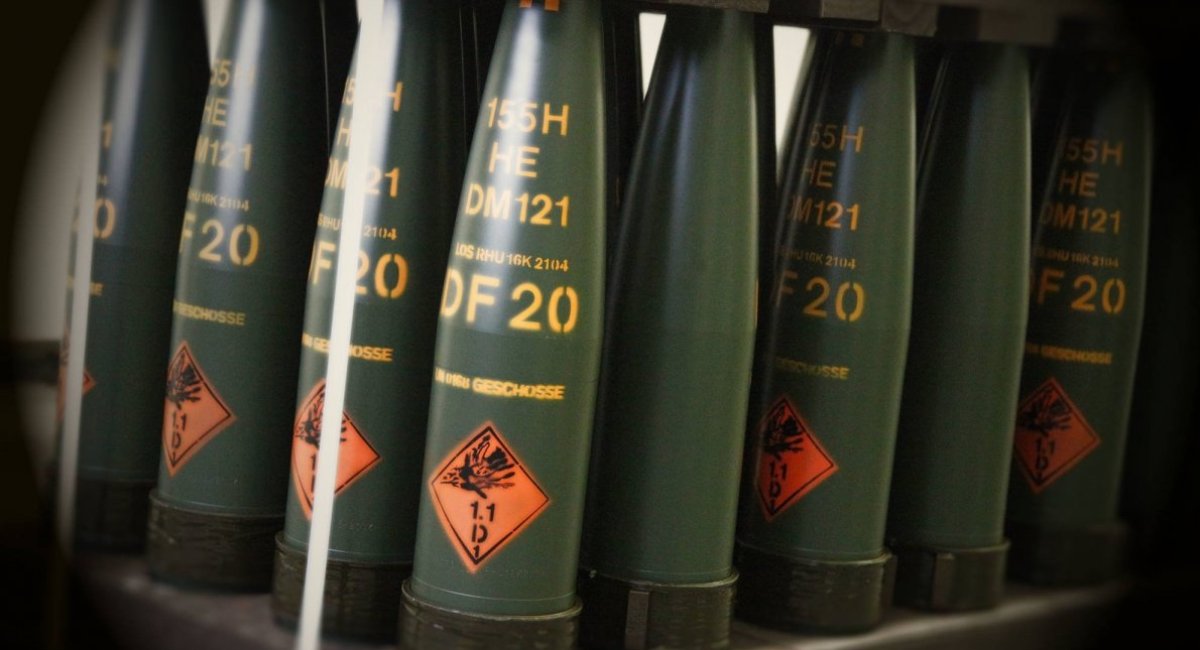
German defense manufacturer Rheinmetall is considering abandoning its plans to establish a 155 mm artillery ammunition factory in Ukraine, more than two and a half years after announcing the project. The company's CEO, Armin Papperger, indicated that the joint venture was unlikely to proceed during Rheinmetall's Capital Markets Day presentation.
The project was initially announced in February 2024, when Rheinmetall signed a Memorandum of Understanding to establish a German-Ukrainian joint venture for local ammunition production. The planned facility was expected to manufacture six-figure quantities of modern 155 mm artillery shells annually, alongside the corresponding propellant charges, to support Ukraine's Armed Forces.
Read more: France Will Make Fewer 155mm Shells in 2029 Than a Single German Rheinmetall Plant Produces Today, Even After, 2.5-Fold Increase
However, despite the initial plans, the project has made little progress. No artillery shells have been produced, and the factory itself has not been established. During the presentation's question-and-answer session, Armin Papperger said he did not expect Rheinmetall to continue with the project, although a final decision has apparently not yet been formalized.
One of the main disagreements concerns the production model. Rheinmetall reportedly wanted to establish a manufacturing arrangement in which the company would play a more substantial role, while its Ukrainian partners insisted on producing the ammunition themselves. Armin Papperger also noted that Ukraine's domestic defense industry has already developed significant capabilities in short- and medium-range artillery ammunition.
He estimated that Ukrainian forces currently fire between 1 million and 1.3 million artillery shells annually, with more than half reportedly manufactured by domestic companies. Although Rheinmetall continues supplying ammunition to Ukraine, primarily through military assistance programs funded by Germany, Denmark, and the Netherlands, Armin Papperger suggested that the Ukrainian market now represents a relatively limited part of the company's business.
The project has also faced persistent bureaucratic and administrative obstacles. Armin Papperger repeatedly complained about difficulties in establishing production facilities in Ukraine. As recently as August 2025, approximately 18 months after the initial agreement, Rheinmetall had reportedly not yet developed a complete construction concept for the factory. More than a year later, the initiative appears close to cancellation.
Nevertheless, Rheinmetall does not appear to be ruling out further cooperation with Ukraine's defense industry. Armin Papperger identified opportunities to supply essential industrial equipment, including presses, that could help Ukrainian manufacturers expand their own ammunition production capabilities.
The company also sees potential in supplying very-long-range artillery ammunition, a category for which Ukrainian manufacturers reportedly still lack the necessary production technologies. This suggests that, rather than establishing a large-scale joint ammunition factory, Rheinmetall may shift toward providing specialized equipment and technologies that complement Ukraine's existing defense-industrial capabilities.
Read more: Rheinmetall Criticizes Ukrainian Bureaucracy Over Delays in Ammunition Plant Project