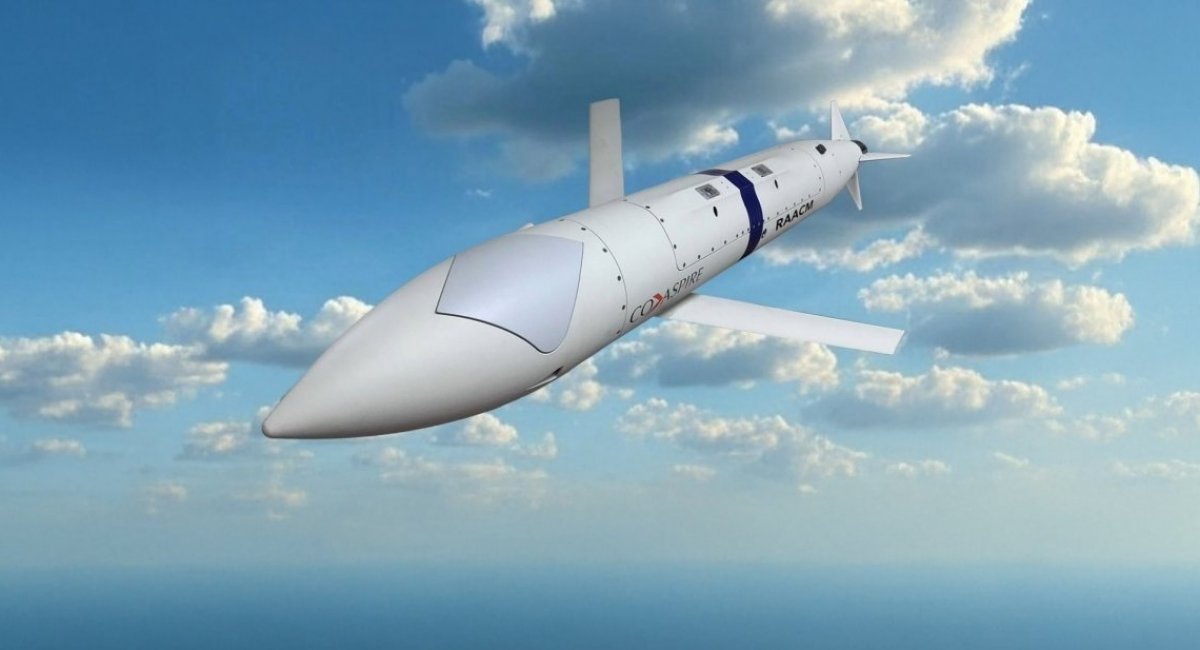
U.S. Navy within CHAOS (Coalition Heterogeneous Affordable Offensive Strike) program ordered development of separate cruise missile versions — Rusty Dagger from Zone 5 Technologies and RAACM from CoAspire. CHAOS program goal is obtaining large quantity of cheap long-range precision engagement assets.
Companies must develop versions of their missiles engaging both ground and moving maritime targets. Meaning for U.S. Navy these cruise missiles must be transformed into anti-ship missiles. For this task Zone 5 Technologies received $65 million, and CoAspire — $70 million, as companies announced in their releases.
Read more: Taiwan Ordered 66 F-16 Block 70s for $8B in 2019, First Two Finally Spotted Leaving U.S. After 6 Years and 8 Months as Taipei Threatens Lawsuit Over $29.7B in Undelivered Arms
Development should be completed by 2028. At same time, first anti-ship missile versions should launch from expeditionary ground launch complexes. Subsequently — from ships (surface launch platforms in original U.S. defense department post), as well as from aircraft.
Recall first Rusty Dagger from Zone 5 Technologies and RAACM from CoAspire versions are made in 500-pound aviation munition dimensions (approximately 250 kg total mass) with approximately 400 km flight range at 0.6 Mach speed. Worth noting for engaging moving surface targets, missiles must be equipped with seekers.
But fact is their integration was immediately provided for during Rusty Dagger and RAACM development. For engaging moving targets they should use QuickSink — compact combined radar and thermal imaging seeker, also designed for use in JDAM kits.
Also worth adding previously Rusty Dagger from Zone 5 Technologies and RAACM from CoAspire received multi-year framework agreements from U.S. Air Force within FAMM (Family of Affordable Mass Missiles) program, which also included Barracuda-500M from Anduril. Pentagon plans to order 27,000 cheap cruise missiles for air forces alone in coming years, directing $12 billion toward this.
At same time, U.S. Army conducts LCCM (Low-Cost Containerized Munitions) program, within which Barracuda-500M from Anduril and RAACM-ER from CoAspire (enlarged version using stealth technologies and with increased range) were chosen in ground launch versions.
Thus, both cruise missiles created for Ukraine within ERAM project participate in armament programs for U.S. Army, Navy and Air Force. Ukraine itself should receive them within $825 million order enabling procurement of 3,350 missiles in aviation version. They are already being used, while rashists complain they proved very accurate.
Read more: Why Did russian Ka-52 Helicopter Fail to Shoot Down Ukrainian FP-1 UAV with Missile, What Alternatives do russians Have